 A Network of People Building Peace
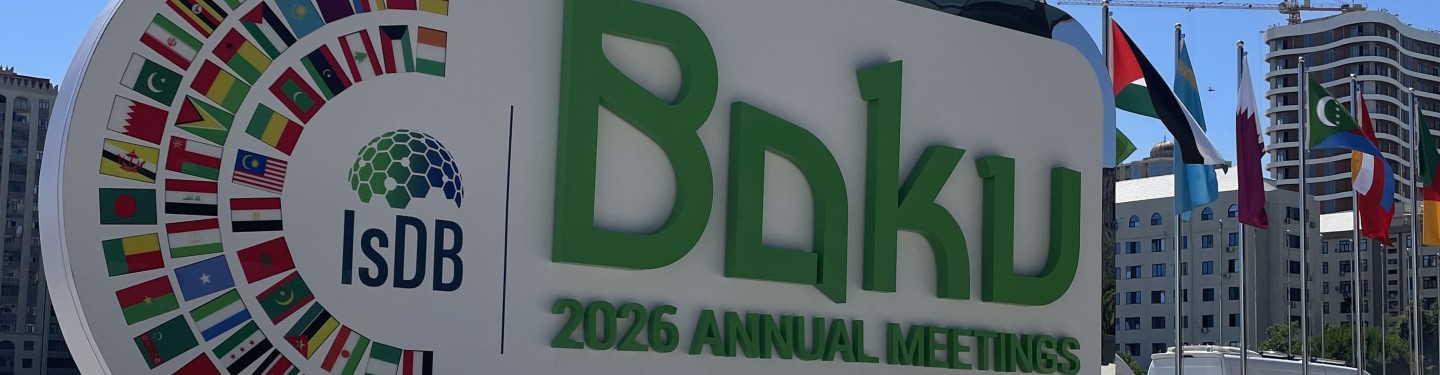
Beyond silos: reflections from the 2026 IsDB Resilience Dialogue
After three days at the inaugural Resilience Dialogue, organised by the Islamic Development Bank (IsDB) alongside its Annual Meetings in Baku (17-19 June), one thing kept striking me.
Whether discussions focused on climate shocks, displacement, agriculture and food security, infrastructure, livelihoods or reconstruction, they consistently returned to the same themes: resilience, preparedness, and the need to move beyond fragmented responses.
I will admit that I arrived with certain assumptions about what an IsDB conference would focus on, especially as it was my first time attending one. I expected discussions to be largely technical and finance-driven. And while the IsDB's mission is to foster both economic development and social progress in its member countries, I was surprised by how consistently participants challenged the idea that infrastructure, investment and service delivery alone can produce resilient societies.
The context helps explain why. Today, the IsDB reports that 32 of its 57 member countries are classified as fragile or vulnerable, and an estimated 400 million people across IsDB member states live in extreme poverty. Against that backdrop, many discussions reflected a growing recognition that development gains are difficult to sustain when institutions are weak, trust is low, and communities face repeated shocks from conflict, climate change and displacement. Traditional approaches alone are no longer sufficient, and sustainable responses increasingly need to span the peace-humanitarian-development spectrum.
Three observations stayed with me.
First, the conversation is shifting from response to resilience.
Several speakers pointed to a persistent tendency from the development and humanitarian sectors to prioritise visible recovery efforts over investments in preparedness, institutional capacity and prevention. The conversation kept coming back to the same question: why do we keep investing so much in rebuilding after crises while underinvesting in the capacities and systems that could help communities better withstand them in the first place?
What also stood out was the argument that fragile contexts should not be viewed primarily through a risk lens. As one participant put it, the question is no longer whether these contexts are too risky to engage in, but whether they are becoming too risky to ignore.
Second, climate is no longer being discussed as an environmental issue alone.
Across sessions, climate shocks were described as drivers of fragility, displacement, livelihood insecurity and social tensions. The climate crisis is reshaping not only development investments and humanitarian needs, but also conflict dynamics and the work of local peacebuilders across our network.
More broadly, I noticed how often development, humanitarian and peacebuilding actors found themselves discussing the same interconnected challenges. Different entry points perhaps, but increasingly similar realities.
Third, resilience is ultimately built through relationships.
One participant remarked that the biggest deficit in fragile contexts is often not infrastructure or finance, but trust. Trust in institutions. Trust between communities. Trust that systems will function when people need them most.
That observation resonated deeply. Roads, schools and health facilities matter enormously. But without social cohesion, legitimate institutions and inclusive decision-making, resilience remains fragile. It also reinforced something that sits at the heart of GPPAC's own approach: lasting resilience depends as much on relationships and trust as it does on technical solutions or investments. When local actors are connected to one another, they are better able to share lessons, adapt to new challenges and learn from what works elsewhere.
Throughout the Dialogue, participants repeatedly emphasised that solutions must be locally led and that external actors should increasingly play a supporting rather than a steering role. For those of us who have spent years advocating for localisation and more equitable partnerships, it was refreshing to hear these ideas articulated so clearly by the IsDB.
This was also reflected in conversations about partnership. During a partner breakfast, IsDB described how it is rethinking partnerships to operationalise its integrated approach, with an emphasis on co-design, co-creation and shared ownership.
What struck me was the willingness to openly question whether traditional approaches are sufficient in a world increasingly shaped by fragility, climate shocks and repeated crises. Combined with the Bank's strong commitment to South-South cooperation, it felt like an institution willing to reflect critically on its own ways of working.
The real test, of course, will be whether these ambitions translate into funding mechanisms and partnerships that are designed with local actors and responsive to their priorities.
As GPPAC finalises its 2026-2030 global strategy, I left Baku with a renewed sense that our network's greatest strength is also its greatest contribution: local peacebuilders rooted in their communities, trusted to work across different levels of society, from communities to governments and across conflict divides, and connected to one another across regions to share knowledge, adapt approaches and strengthen collective action for peace.