 A Network of People Building Peace
Bridging the Nexus: Building complementarity with the AU-PCRD, Arab League and IsDB
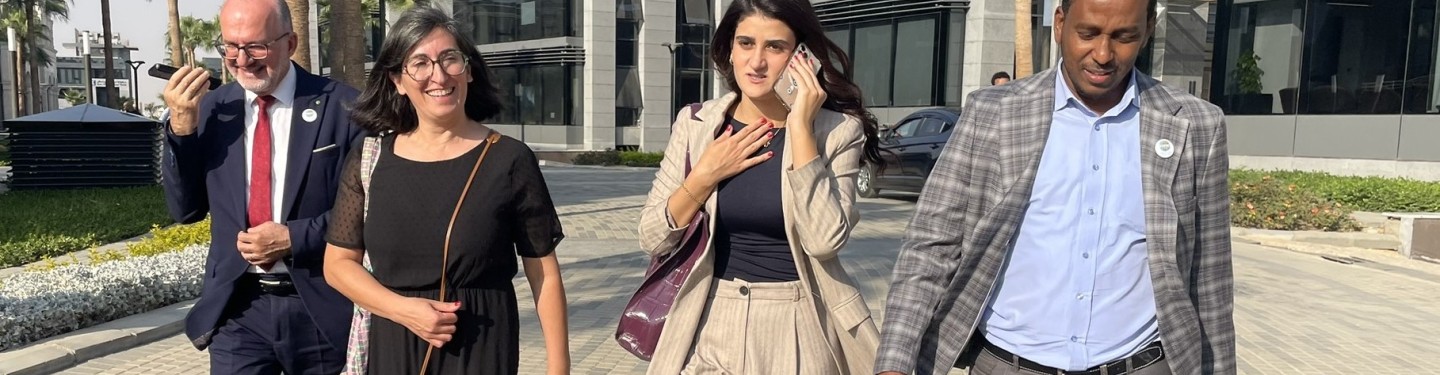
In early September, GPPAC members from East and Central Africa, the Middle East and West Africa, together with colleagues from the Global Secretariat, gathered in Cairo for a policy-influencing workshop. The workshop focused on identifying policy priorities, the key moments, actors and institutions members need to engage with, and how to approach them nationally, regionally and globally, including where members could learn from and support one another.
We also wanted to use our time in Cairo to look beyond our own network. Building on the priorities identified by members, particularly around strengthening connections across the humanitarian-development-peace nexus and bringing local peacebuilding perspectives into policymaking, we met with three regional institutions GPPAC members had identified as particularly relevant to their work: the African Union Centre for Post-Conflict Reconstruction and Development (AU-PCRD), the League of Arab States and the Islamic Development Bank (IsDB). The conversations were an opportunity to better understand how these institutions approach issues that GPPAC members are also working on, and to explore where the knowledge and experience of local peacebuilders could complement their work.
And despite their different mandates and geographical reach, one message came through particularly strongly: today’s crises cannot be addressed through humanitarian, development and peacebuilding efforts working in parallel. Across the three conversations, we heard a similar ambition to strengthen the connections between prevention, crisis response, recovery and longer-term resilience, and to build greater complementarity between the actors working across these areas. This also means stronger connections with local civil society organisations, which are often disconnected from institutional processes despite holding much of the local knowledge, relationships and experience needed to make policies and interventions more relevant and sustainable. A network like GPPAC can help bridge that gap by bringing locally rooted peacebuilding knowledge into these processes.
This reflection looks at what we heard from the three institutions, where their approaches intersect with the priorities of GPPAC members, and what this could mean for stronger engagement between regional institutions and local peacebuilders.
Across the three institutions, this ambition is taking different forms. The AU-PCRD is putting into practice a revised approach to peacebuilding that, rather than focusing mainly on what happens after conflict, spans the full conflict cycle, before, during and after violence. GPPAC members similarly work across these different stages, creating natural areas of complementarity. Our conversation highlighted several, including psychosocial support, women and youth, and ensuring that regional and national plans are informed by and implemented with local communities.
At the League of Arab States, our conversation focused on the organisation’s role in mediation and conflict prevention and, importantly, on what happens after violence ends. Our counterparts saw the League’s new leadership as creating opportunities for stronger engagement in this area. We explored post-conflict reconstruction in contexts such as Sudan and Syria, not only in terms of rebuilding infrastructure, but also of rebuilding the human and social fabric needed to prevent conflict from recurring. This included the role of transitional justice and Track II dialogue, where locally rooted networks such as GPPAC can contribute through relationships and trust built over time.
At IsDB, this thinking is already being translated into a new financing mechanism, the Response, Recovery and Resilience (3R) Facility. The Facility was created specifically to bridge emergency response, early recovery and longer-term resilience, recognising that resilience cannot simply begin once an emergency is over. Its approach connects humanitarian response, recovery and longer-term investment, with prevention and early warning cutting across the different stages. Particularly relevant for GPPAC, it explicitly includes social cohesion and community peacebuilding within early recovery and recognises a role for local and national CSOs as implementing partners.
These conversations strongly resonated with the discussions taking place in our closed policy influencing workshop. Participants from East and Central Africa, the Middle East and West Africa similarly called for a more integrated triple nexus approach: when shocks occur, whether driven by violent conflict, climate change or other crises, communities cannot prioritise humanitarian, development or peacebuilding responses over one another. Rather, these efforts need to reinforce one another from the outset.
For GPPAC, this underscored that the triple nexus is increasingly moving from policy concept to practice. As institutions develop new strategies, mechanisms and partnerships, local peacebuilding knowledge and expertise need to inform the policies, financing and programmes being developed regionally and globally.
Ultimately, bridging the nexus requires system change. It means developing better policies while also changing how institutions work together, whose knowledge informs decisions, and how peacebuilding is financed. This includes accessible and flexible funding that enables integrated approaches and allows local CSOs to play a meaningful role rather than remaining at the margins of institutional responses. This is something GPPAC has long advocated for and will continue to work towards.
These meetings were also a useful reminder that policy influencing starts with listening and sharing. By understanding each other’s priorities, sharing knowledge and identifying areas of complementarity, we can move from common understanding towards practical collaboration and continue building connections between institutional actors and local peacebuilders.